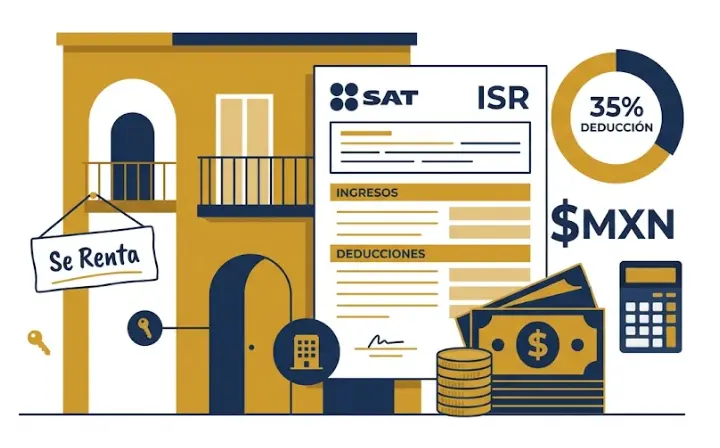
In Mexico, rental income is subject to ISR and in some cases IVA from day one. Failing to declare is tax evasion, with fines up to $97,000 MXN and RFC cancellation.
What is the rental income tax regime?
The arrendamiento (rental income) regime is the fiscal framework under which individuals must pay tax when they earn income from renting real estate: houses, apartments, commercial spaces, warehouses, offices or land. It is regulated under Chapter III of Title IV of the Mexican Income Tax Law (LISR).
Unlike employees (whose employer withholds tax) or PFAE freelancers (who pay ISR on fees), landlords are directly responsible for calculating and paying their tax monthly to SAT.
Who must file under the rental income regime?
All individuals who receive income from renting are required to register their RFC under this regime and file declarations, including those renting residential, commercial, industrial properties, land or parking spaces, as well as those subleasing or offering timeshare arrangements.
Two options to calculate ISR on rental income
Mexican law allows you to choose between two methods to determine the taxable base. The right choice can mean thousands of pesos difference each year.
Option 1 — Blind deduction (35% flat)
You may automatically deduct 35% of gross rental income without proving any expenses, plus the property tax (predial) for the period if you paid it.
Blind deduction: $20,000 × 35% = $7,000
Taxable base: $20,000 − $7,000 = $13,000
ISR (~21.36% bracket): ~$2,776/month
Advantage: No invoices or receipts needed. Ideal when the property generates few real expenses.
Disadvantage: If your real expenses exceed 35%, you are overpaying ISR.
Option 2 — Real deductions (documented expenses)
You may deduct actual expenses incurred on the property, provided they have CFDI invoices in your name:
- Real mortgage interest on the rented property
- Property tax and maintenance fees
- Property insurance premiums
- Property manager or real estate agency fees
- Maintenance, repairs and renovation expenses
- Property depreciation (3% per year on construction cost, not land value)
- Notary and acquisition costs (deductible in the year of purchase)
Advantage: If you have a mortgage, high maintenance costs or accumulated depreciation, you can pay significantly less ISR.
Disadvantage: Requires keeping invoice records and correctly computing depreciation.
Which option is better for you?
| Situation | Recommended option |
|---|---|
| Paid-off property with few expenses | Blind deduction 35% |
| Active mortgage on the rented property | Real deductions (interest may exceed 35%) |
| Recently renovated or high-expense property | Real deductions |
| Multiple rental properties | Case-by-case analysis — consult accountant |
| Short-term rental platforms (Airbnb) | Depends on income level and operational costs |
Monthly provisional payments: how and when
Landlords must file monthly ISR provisional payments, by the 17th of the month following the one in which income was received. January rent must be declared and paid by February 17th. Payments are made through the SAT portal using your RFC and password (or e.firma for high amounts).
If your tenant is a company (persona moral), they are required to withhold 10% ISR on the monthly rent. Your provisional payment to SAT is then reduced by this already-withheld amount. Always request the withholding CFDI from your corporate tenant.
IVA (VAT) on rental income: when it applies
| Property type | IVA | Note |
|---|---|---|
| Residential housing (exclusively for living) | Exempt | No IVA if purely residential |
| Commercial space, office, warehouse | 16% | Must charge IVA to tenant and file monthly |
| Furnished apartment / mixed use | 16% | If hospitality or commercial elements exist |
| Parking | 16% | Temporary use of real estate = IVA applies |
| Digital platforms (Airbnb, short-term) | 16% | Platform may withhold and remit IVA |
Rental income and the annual tax return
Landlords must file a SAT annual declaration reconciling all monthly provisional payments with the actual annual ISR, including personal deductions (medical expenses, health insurance, AFORE contributions, etc.) that can further reduce the tax bill. See the complete guide to deductible expenses.
Rental on digital platforms (Airbnb, Booking)
Since the 2020 reform, digital platform rentals have specific tax treatment:
- The platform (Airbnb, Booking, etc.) may act as an ISR and IVA withholder if it offers this service in Mexico
- If the platform withholds, you pay tax at a simplified flat rate on collected income
- If the platform does NOT withhold, the host must declare as standard rental income
- Platform rental income is always taxable, even for occasional rentals of a few days per month
Consequences of not declaring rental income
- Omission fine: $1,810–$45,750 MXN per unfiled declaration
- Surcharges: 0.98% monthly on unpaid ISR plus inflation adjustment
- RFC restriction: SAT can cancel your digital stamps for issuing CFDI invoices
- Audit: SAT cross-references bank deposits, registered contracts and CFDIs issued by tenants
See the full penalty range in our guide to SAT fines in Mexico.
Frequently asked questions about rental income tax in Mexico
Can I rent my property without RFC?
Not legally. To issue the rental CFDI that most tenants (especially companies) require, you need an active RFC with the rental income regime. Registration is free — see our guide on what is RFC and how to get it.
If I only rent for 3 months a year, do I need to declare?
Yes. There is no minimum time threshold or income minimum that exempts you from declaring rental income in Mexico. Any rental income, even occasional, generates a tax obligation. Declarations are filed only for months with activity.
Who issues the rental CFDI — landlord or tenant?
The landlord issues the CFDI to the tenant for each rent payment received. If the tenant is a company, they additionally issue a withholding CFDI for the 10% ISR they retain.
Can I deduct the property I bought to rent out?
Not directly, but you can deduct depreciation (3% per year on the construction value, excluding land) as a property expense when using real deductions. Acquisition and notary costs are also deductible in the year of purchase.
Renting a property in Mexico and unsure if you are declaring correctly?
Our accountants review your situation, calculate whether the blind or real deductions work better for you and handle all your monthly payments and annual return. Service in Spanish, English and Russian.
Free consultation →