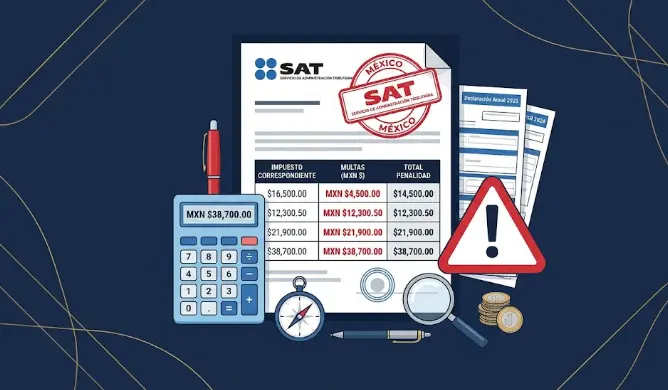
The deadline for the individual annual tax declaration is April 30, 2026. Missing the deadline or filing with errors triggers automatic fines that compound month after month.
What are SAT fines?
SAT fines are financial penalties imposed by Mexico's tax authority (Servicio de Administración Tributaria) on taxpayers who fail to meet their fiscal obligations. They are governed primarily by Articles 76 to 91 of the Federal Fiscal Code (CFF) and are updated annually based on the Unit of Measure and Update (UMA).
Contrary to popular belief, SAT can detect non-compliance automatically by cross-referencing CFDI invoices, declarations, the tax mailbox and financial institution reports. No formal audit is required to receive a fine.
Most common fines and how much they cost
Below are the most frequent violations and their fine ranges currently in force for 2026:
| Violation | Minimum fine | Maximum fine | Legal basis |
|---|---|---|---|
| Not filing the annual declaration | $1,560 MXN | $38,700 MXN | CFF Art. 81-I |
| Not filing monthly declarations (ISR/IVA) | $1,560 MXN | $38,700 MXN | CFF Art. 81-I |
| Not issuing a CFDI per transaction | $17,020 MXN | $97,330 MXN | CFF Art. 83-VII |
| Not keeping electronic accounting records | $260 MXN | $3,640 MXN | CFF Art. 83-I |
| Not filing informational returns (DIOT) | $1,400 MXN | $17,370 MXN | CFF Art. 81-II |
| Not registering with RFC when required | $3,030 MXN | $9,090 MXN | CFF Art. 80-I |
| Errors or omissions in CFDI data | $400 MXN | $5,210 MXN | CFF Art. 83-XI |
| Not responding to tax mailbox requirements | $3,850 MXN | $11,540 MXN | CFF Art. 86-I |
| Failing to withhold or remit third-party taxes | $13,480 MXN | $134,830 MXN | CFF Art. 79-II |
| Qualified tax fraud | 3–9 years imprisonment + fine of 55%–75% of the evaded amount | CFF Art. 108 | |
If you have gone three months without issuing a CFDI for 50 transactions, the fine applies per invoice not issued. In that scenario the total could exceed $800,000 MXN. This is not an extreme case — it has happened to mid-volume freelancers.
Surcharges: the cost of not paying on time
In addition to the fine itself, SAT charges surcharges (recargos) on unpaid tax. The current 2026 rate is 1.47% per month (17.64% annually). This compounds with the inflation adjustment (INPC), making the debt grow exponentially over time.
| Months overdue | Accumulated surcharges (on the tax) | INPC adjustment (estimate) |
|---|---|---|
| 3 months | 4.41% | ~2% |
| 6 months | 8.82% | ~4% |
| 12 months | 17.64% | ~8% |
| 24 months | 35.28% | ~16% |
That means an unpaid tax of $50,000 MXN can become a debt of over $75,000 MXN in two years from surcharges and adjustments alone — before counting the formal fine.
How to check for outstanding fines
- Go to sat.gob.mx → "Servicios" → "Opinión de cumplimiento".
- Log in with your RFC + SAT password or your e.firma.
- The system shows your real-time compliance status: positive (up to date) or negative (detected debts or non-compliance).
- If you have pending notifications, check your tax mailbox for requirements or resolutions.
How to reduce or have SAT fines waived
1. Spontaneous correction (before SAT notifies you)
If you file or correct your declaration before receiving a formal SAT notification, you are entitled to a 100% reduction — or even elimination — of the fine. This is the most favourable option: CFF Art. 73 grants full fine waiver when the taxpayer acts spontaneously.
2. Payment during a review process
If SAT has already started a review but has not yet issued a final resolution, you can self-correct with a 20% reduction on the calculated fine (CFF Art. 76).
3. PRODECON conclusive agreement
The PRODECON (Taxpayer Defence Ombudsman) offers a conclusive agreement mechanism to reach a settlement with SAT before the final resolution, with fine reductions of up to 100% for a first-time infraction.
4. Revocation appeal
If you have already received a formal fine and believe it is incorrect, you can file a revocation appeal with SAT within 30 business days of notification. If SAT rules against you, you can take the case to the Federal Administrative Justice Tribunal (TFJA).
Special situations: foreigners and companies
If you are a foreigner operating in Mexico or have a company incorporated in Mexico, the fine regime applies exactly the same as for Mexican nationals. Higher-risk scenarios include:
- Receiving international payments without declaring: Undeclared transfers from abroad can trigger automatic SAT requirements. Learn how to correctly declare international payments.
- Incorrect deductions: Expenses not backed by CFDI can result in fines and ISR adjustments. See which expenses are deductible.
- RESICO without meeting simplified obligations: Non-compliance in RESICO also generates fines. Check how to register in RESICO correctly.
Frequently asked questions about SAT fines
Do SAT fines expire?
Yes. The general statute of limitations is 5 years from the date the tax should have been paid or the declaration filed (CFF Art. 67). However, SAT can interrupt this period with notifications, collection actions or if the taxpayer acknowledges the debt.
Can I pay a SAT fine in instalments?
Yes. SAT offers instalment payment plans for tax debts (taxes + fines + surcharges), formalised through a deferred payment request at the SAT office or online portal. A tax credit guarantee may be required for significant amounts.
Does a SAT fine affect my credit history?
Not directly in the credit bureau, but it does generate a negative compliance opinion. Many companies and banks request this opinion before signing contracts or granting credit. An unresolved fine can block you from public tenders and financing.
What happens if I ignore a SAT notification?
SAT can proceed to forced collection: bank account seizure, asset liens or wage garnishment — without prior court proceedings — once the tax credit is firm. Always address any communication in your tax mailbox within the stated deadlines.
Received a SAT fine or want to prevent one?
Our accountants review your tax situation, detect risks before a fine arrives and represent you before SAT if one already has. Service in Spanish, English and Russian. First consultation free.
Free consultation →