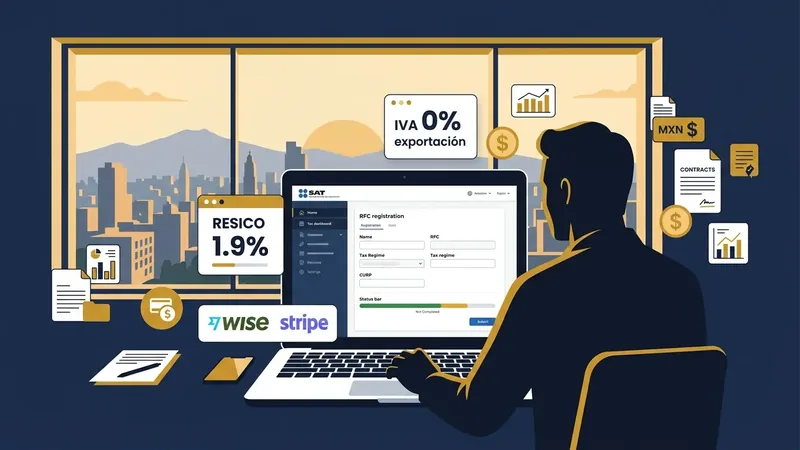
The mistake 80% of digital nomads in Mexico make
The logic seems straightforward: arrive on a tourist visa, work for clients outside Mexico, collect in dollars to a foreign account. SAT has no reason to know you exist. Many nomads operate this way for months, even years.
The problem is that SAT is getting better at tracking exactly these situations. It cross-references rental data with corporate tax filings, receives data from digital platforms under OECD automatic exchange agreements, and since 2024 has access to Stripe, PayPal and Wise Mexico data when they operate with Mexican clients. A Mexican client who pays you and requests an invoice leaves a trail. An apartment rented in CDMX under a signed contract leaves a trail. A BBVA Mexico account leaves a trail.
But the most immediate risk is not SAT finding you. It is that many nomads become tax residents without knowing it and accumulate months of unfiled obligations with 1.47% monthly surcharges plus inflation adjustment before anyone explains what they already owed.
When exactly does your fiscal obligation in Mexico begin?
Article 9 of the Federal Tax Code (CFF) establishes two independent criteria for determining tax residency:
| Criterion | What it means in practice | Requires 183 days? |
|---|---|---|
| 183 days of presence (accumulated in 12 months, not necessarily consecutive) | You spend more than 6 months in Mexico between January and December | Yes — the well-known threshold |
| Center of vital interests in Mexico | Your main economic activity is here: local clients, employees, office, extended lease | No — can activate earlier |
The second criterion is what catches most nomads off guard. If in 90 days in CDMX you have contracts with three Mexican clients, a rented office and a CLABE account, SAT can argue your "permanent establishment" is in Mexico — and apply Title V ISR (withholding on non-resident gross income) or even require you to register as a full tax resident.
The four fiscal scenarios for a nomad in Mexico
| Situation | SAT status | Tax burden | Main obligation |
|---|---|---|---|
| Under 183 days, foreign clients only, no Mexican bank account | Non-resident | Low (Title V withholding only if Mexican-source income) | None in Mexico if no national income source |
| More than 183 days in the calendar year, regardless of client type | Mandatory tax resident | ISR 1.92%–35% on worldwide income | RFC + monthly declarations + annual return |
| Temporary or permanent residency obtained from INM | Tax resident from day one of residency | Progressive ISR on worldwide income from registration date | Immediate RFC + correct regime + VAT if commercial activity |
| Employed by a Mexican company (labor relationship) | Employee | ISR withheld by employer (Art. 96 LISR table) | Employer withholds and remits — employee does not file if this is their only income |
Which tax regime suits a digital nomad in Mexico best
Once you decide (or SAT decides for you) that you are a tax resident, regime selection is crucial. These are the three that apply to most freelance digital nomads:
RESICO — Simplified Confidence Regime
The simplest regime and, for most nomads, the most advantageous. You pay monthly ISR on gross revenue at rates between 1% and 2.5% (exact rate depends on income level). No expense deductions — meaning that if you have high operating costs, RESICO may not be optimal.
The annual RESICO ceiling is $3,500,000 MXN (approximately $175,000 USD). If you exceed it during the year, SAT automatically switches you to the general regime the following January.
The big advantage for nomads with European or North American clients: services provided to foreigners qualify as service exports with 0% VAT (Art. 29, Section IV of the VAT Law), provided the service is used abroad. You do not charge VAT to international clients — but you can credit the VAT on your Mexican expenses. For full detail on structuring these invoices, see our guide on service exports and 0% VAT.
General PFAE — Business and Professional Activity Regime
This regime allows deducting real expenses: office rent, equipment, internet, software, business-related travel. ISR is calculated on profit (income minus deductions) at progressive rates from 1.92% to 35%. If your operating costs are high, this can result in a lower tax burden than RESICO. The trade-off is full electronic accounting, monthly DIOT filing, and maintaining CFDI receipts for all deductible expenses.
SA de CV — Corporation
Only financially justified when income exceeds a certain level (generally over $5-6 million MXN annually) or when there is a multi-partner structure. Corporate ISR is 30% on profit, but dividend planning can reduce the effective rate for partners. Compliance costs (accountant, declarations, DIOT, audited financial statements) are significantly higher. If you are considering this, first read our SA de CV vs SAPI de CV comparison.
How to register with SAT as a digital nomad
The process has a prerequisite that stops many: you need a CURP to get an RFC, and tourists (FMM visa holders) do not automatically have a CURP.
Route for nomads on tourist visa (FMM)
- Apply for Temporary Residency visa at INM (requires proving income of approx. $46,924 MXN/month or average savings of $562,000 MXN over the last 12 months — 2026 figures).
- With the residency card, apply for CURP at RENAPO (online or in person).
- With CURP, register for RFC at the SAT portal or at a module.
- Apply for e.firma (first time, in-person at SAT — see our complete e.firma guide).
How to receive payments from foreign clients as a Mexican tax resident
If you are a tax resident with RFC, you technically must issue a CFDI for every payment received, including from abroad. In practice, SAT has evolved its position: for foreign-source income that does not pass through the Mexican invoicing system, the CFDI obligation can be met through the DIOT filing and monthly ISR declaration, using bank statements and the client contract as supporting documents.
| Platform | Mexican CLABE? | CFDI obligation | Tax notes |
|---|---|---|---|
| Wise | Yes (Wise Mexico, CLABE available) | Does not auto-generate CFDI — you or your accountant must issue it | From 2026, Wise Mexico reports transactions to SAT above certain thresholds. Using it as a bridge account followed by transfer to a Mexican account is the cleanest flow. |
| Deel | No directly — pays to foreign account or Wise | Deel is a payroll intermediary, not your client. The foreign company is who contracts you; Deel only pays. | If you are in RESICO and receive from Deel, your monthly Deel income is your taxable revenue — declare based on that. |
| Stripe | Yes (Stripe Mexico for MX accounts) | Stripe issues its own receipts but not CFDIs. You must issue CFDI per charge if client requires it; for foreign clients you can accumulate and declare monthly. | Stripe Mexico reports to SAT if you exceed $600 USD in the year (FATCA/CRS rule). Never assume your Stripe account is invisible. |
For a complete guide on legally structuring international payment receipt, including using foreign accounts alongside your Mexican RFC, see our article on receiving international payments in Mexico.
Russian and Ukrainian nomads: the structural problem without a tax treaty
Mexico has double taxation treaties with 14 countries (including the US, Spain, Germany, Canada, UK and Japan). Neither Russia nor Ukraine are on that list. For a Russian or Ukrainian nomad who accumulates more than 183 days in Mexico, this creates a potentially costly situation:
- Mexico taxes them as a fiscal resident on worldwide income.
- Their home country may continue taxing them if they maintain domicile, assets or fiscal ties there.
- There is no bilateral mechanism to avoid double taxation.
The most common planning strategy for this profile at Nexoconsult is: (1) leaving Mexico before day 183 to avoid residency, or (2) establishing tax residency in a third country with a Mexico treaty before exceeding 183 days. Spain, for example, has an active treaty with Mexico. This requires specific planning and should not be done without professional guidance.
For full detail on which treaties exist and their real limitations, see our guide on double taxation in Mexico and tax treaties. And if you need to understand your general obligations as a foreigner, our article on tax obligations for foreigners in Mexico covers the full picture.
What you actually pay: three cases with real numbers
Case 1 — Freelancer in RESICO, $8,000 USD/month from European clients
Monthly income: ~$160,000 MXN (at approx. $20 MXN/USD).
VAT on invoices to European clients: 0% (service export).
Monthly ISR in RESICO on $160,000 MXN: approx. $3,040 MXN (rate ~1.9%).
Annual ISR total: ~$36,480 MXN (~$1,824 USD).
Effective tax burden on gross income: approx. 1.9%.
This is the optimized scenario: RESICO + foreign clients + service used outside Mexico = 0% VAT, minimal ISR, no complex accounting.
Case 2 — Same freelancer, no RFC, discovered by SAT at month 14
SAT determines retroactive tax residency from month 7 (183 days). Calculates 8 months of omitted ISR ($3,040 MXN × 8 = $24,320 MXN) plus 1.47% monthly surcharges, plus penalty for unfiled declarations (20% to 75% of omitted tax under Art. 76 CFF), plus inflation adjustment. The total can easily reach $45,000–$60,000 MXN — triple what they would have paid by registering from the start.
Case 3 — Developer earning $18,000 USD/month via an SA de CV
Corporate ISR: 30% on profit (not gross income). If the company has $360,000 MXN revenue and $180,000 MXN in deductible expenses (rent, payroll, services, equipment), profit is $180,000 MXN. Corporate ISR: $54,000 MXN. Dividend distribution to partner: additional 10% withholding. But the SA de CV allows separating director-partner salary (deductible for the company, with employment ISR withholding) from dividends — the combination can reduce effective burden vs general PFAE. Requires a permanent accountant and full monthly compliance.
Been in Mexico a while and not sure if you are already a tax resident?
The Nexoconsult team reviews your immigration and tax situation, calculates your retroactive obligations (if any) and designs the most efficient structure for your profile — whether you are a European freelancer, a Russian nomad or an entrepreneur with Mexican clients. Personalized service in Spanish, English and Russian.
Free consultation →Frequently asked questions
How long can I stay in Mexico as a digital nomad without paying taxes?
Legally, you can stay up to 180 days on a tourist visa (FMM) without obligations as a tax resident — as long as you do not generate income from Mexican sources and your "primary home" is not in Mexico. However, Article 9 of the Federal Tax Code states that tax residency also activates when your "center of vital interests" is in Mexico (where your main economic activity takes place), even if you have not reached 183 days. In practice: if you are renting an apartment, have a fixed coworking space and all your clients know you are in CDMX, SAT can argue tax residency even if you have only been there 90 days. The 183-day threshold is the most widely known, but not the only one.
Can I work as a digital nomad in Mexico without an RFC?
Technically, if you are a non-tax resident (fewer than 183 days, no permanent establishment in Mexico and no Mexican-source income), you have no obligation to register for RFC. However, if you invoice Mexican clients, rent an office, hire anyone locally or receive payments through the Mexican banking system, SAT can interpret you as having a permanent establishment and apply Title V withholding (up to 25% on gross income). Without RFC you cannot issue CFDI, which blocks you from working with Mexican corporate clients who require invoices. And without RFC you cannot access RESICO, the most favorable regime for freelancers with foreign income. The practical conclusion: if you plan to stay more than 3-4 months or work with any Mexican client, registering for RFC early is cheaper than the consequences of not doing so.
How does a digital nomad in Mexico declare taxes when earning in dollars or euros?
Foreign currency income is converted to Mexican pesos at the Bank of Mexico exchange rate on the day it is received (Art. 8 LISR). If you collect via Wise, Deel, Payoneer or direct bank transfer, the income date is when the money becomes available in your account. Each payment in dollars or euros must be converted at that specific day's rate — you cannot use a monthly average. Under RESICO (the most common regime for freelancers), you pay monthly ISR of 1% to 2.5% on the peso-converted income, with no deduction for expenses. If you have European or US clients and are a Mexican tax resident, the VAT on those invoices is 0% (service exports under Art. 29 of the VAT Law) — this is a real advantage compared to charging 16% IVA to Mexican clients.
What happens if I am from Russia or Ukraine and work from Mexico as a digital nomad?
This is the highest-risk fiscal situation for nomads in Mexico. Neither Russia nor Ukraine has a double taxation treaty with Mexico. This means that if you are a Mexican tax resident (more than 183 days) and still maintain tax obligations in your home country, you could end up declaring and paying taxes in both countries on the same income — without any tax credit to offset it. The most common strategy is to leave Mexico before 183 days and maintain non-resident status, but this requires careful planning and can in some cases conflict with Art. 9 CFF if your economic center is clearly in Mexico. A second option is to establish tax residency in a third country that does have a treaty with Mexico (Spain, for example, has an active agreement). The Nexoconsult team works specifically with Russian and Ukrainian clients in Mexico — this is one of the situations that most requires specialized advice before making residency decisions.
Which tax regime is best for a digital nomad in Mexico in 2026?
For most digital nomads with foreign income below $3,500,000 MXN annually (approx. $175,000 USD), RESICO (Régimen Simplificado de Confianza) is the most efficient option: monthly ISR of 1% to 2.5% on revenue, no requirement for complex accounting, declaration in minutes via the SAT app. VAT on services to foreign clients = 0%. If your income exceeds that limit, or you have employees or significant expenses you want to deduct, the Business and Professional Activity Regime (general PFAE) allows deducting real expenses but requires keeping full monthly accounting, DIOT filing, and ISR calculation using the progressive table from 1.92% to 35% on profit. For high-income earners with multiple clients and consolidated business structure, an SA de CV can reduce the effective rate through planned dividends — but setup and compliance costs run $6,000–$15,000 MXN monthly and only makes financial sense above a certain income level.