Accountant in Mérida 2026: fiscal residency, foreign pensions and Yucatán payroll tax for expats
20 Oct 2026|20 min read
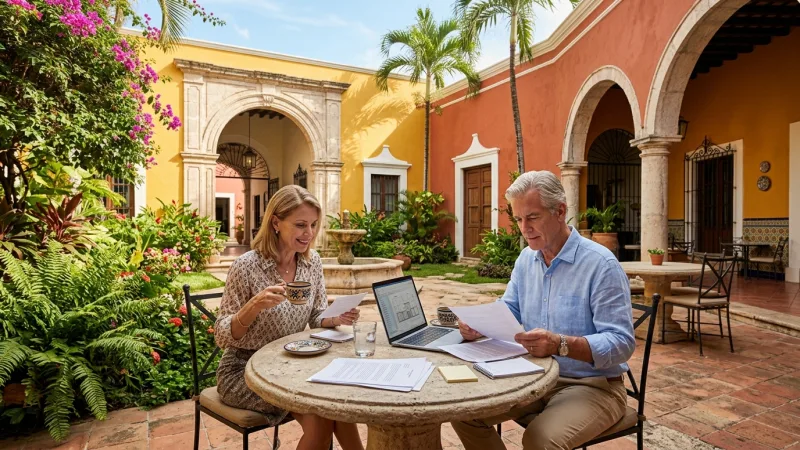
Tom and Patricia Walsh arrived in Mérida in January 2024 with permanent residency. They receive US Social Security, annual 401k withdrawals, and rent their colonial house on Airbnb to American families. Their Florida CPA told them "Mexico does not tax foreign retirees." Sixteen months later, SAT sent them a notice: they have spent more than 183 days per year in Mexico — they are Mexican tax residents — and must declare their worldwide income to SAT. Social Security partially exempt under the tax treaty, 401k withdrawals taxed at 30%, Airbnb rental income with unpaid ISR and VAT, and a cleaning employee for whom they never paid Yucatán's 2% payroll tax. An accountant specialized in Mérida expats prevents this scenario from the first day of residency.
Mérida is Mexico's fastest-growing city for foreign residents. More than 30,000 Americans, Canadians, and Europeans have established permanent residency in the Yucatán capital, attracted by the cost of living, safety, and climate. What many do not know upon arrival: living in Mérida more than six months per year makes them Mexican tax residents — with all the tax obligations that entails. The most costly mistake in Mérida's expat community is not financial or safety-related: it is fiscal.
Tax residency in Mexico: the 183-day rule
Article 9 of the Federal Tax Code establishes that a foreigner becomes a Mexican tax resident when they spend more than 183 days in Mexican territory in a calendar year — continuous or cumulative. It does not matter that they maintain permanent residency in the US, Canada, or Europe; it does not matter that they continue paying taxes in their home country. If they spend more than half the year in Mexico, they are a Mexican tax resident and must declare their worldwide income to SAT.
When does a day count in Mexico?
Any fraction of a day in Mexican territory counts as a full day toward the 183 count
Transit days (layovers) generally do not count without an overnight stay
Cumulative days in the calendar year (Jan 1–Dec 31) are added together — they do not need to be consecutive
Crossing to the US for a weekend and returning does not "reset" the annual counter
SAT can request immigration records, passport stamps, and bank statements to verify days of presence
Foreign pensions and 401k withdrawals with SAT: what the Mexico-US treaty says
The tax treaty between Mexico and the United States (in force since 1994) establishes specific rules to avoid double taxation for US retirees in Mexico. Key points:
Income type
Where taxed
Mexico exemption
Credit
Social Security (public pension)
Mexico (tax resident)
Up to 15 daily min. wages (~$20,100 MXN/mo)
IRS withheld tax
Private pension (defined benefit)
Mexico (tax resident)
Up to 15 daily min. wages if lifetime
IRS withheld tax
401k / IRA withdrawal
Mexico (tax resident)
No specific exemption
IRS withheld tax
Canadian RRSP
Mexico (tax resident)
Mexico-Canada treaty, Art. 18
CRA withheld tax
Foreign stock dividends
Mexico (tax resident)
No exemption applies
Withheld at source
Airbnb in Mérida: the accommodation vs. leasing distinction SAT actually audits
Mérida has a rental market completely different from Cancún or Los Cabos. Most stays in Mérida — especially in Centro Histórico and Norte neighborhoods — are 30 days or longer: American families "testing" the city before relocating, digital nomads on 1-3 month stays, newly arrived retirees looking for a home. This duration classifies most rentals as leasing under the LISR — not accommodation.
Item
Accommodation (<30 days)
Leasing (≥30 days)
LISR article
Art. 113-A (platforms)
Art. 114 (leasing)
Airbnb ISR withholding
4% provisional
Does not withhold
Airbnb VAT withholding
8%
Not applicable (exempt)
Taxpayer VAT
16% (accommodation)
Exempt (residential)
Expense deductions
No (final payment)
Yes (property tax, maintenance, insurance)
Typical tax burden
4% on gross income
Progressive ISR on net income
Yucatán payroll tax: 2% rate and who pays it in Mérida
The Yucatán payroll tax is 2% monthly — one of the lowest rates in Mexico. Administered by the SAF-YUC. For expat homeowners in Mérida, the surprising obligation involves domestic employees: if they regularly employ someone for cleaning, gardening, or care — even just three days a week — they likely have a labor relationship that requires IMSS, INFONAVIT, and the 2% Yucatán payroll tax.
State
Payroll tax
Administrator
Mexico City
3.0%
CDMX Treasury
Jalisco
2.5%
Jalisco Finance
Baja California
2.5%
SHBC
Querétaro
3.0%
SHQ
Nuevo León
2.0%
NL Finance
Yucatán (Mérida)
2.0%
SAF-YUC
Digital nomad in Mérida: the Permanent Establishment risk
Digital nomads with companies in the US (LLC), Spain (SL), or any other country who work from Mérida face a specific risk few generalist accountants know: Permanent Establishment (PE). If the nomad works from Mérida more than 183 days with their foreign company — especially if signing contracts, making commercial decisions, or managing operations from Mexico — the foreign company may qualify as a PE in Mexico, making it taxable by SAT as if it were a Mexican company. A specialist accountant in Mérida can structure the operation to minimize PE risk through proper formalization of services or by establishing an appropriate Mexican entity.
Nexoconsult services for expats in Mérida:
Tax residency determination and SAT notice (registration or residency change)
Annual declaration with worldwide income: pensions, 401k, foreign rentals
Mexico-US/Canada tax treaty application to avoid double taxation
Monthly rental declaration (Airbnb) under correct regime
SAF-YUC payroll tax registration and filing for domestic employees
Permanent Establishment analysis for digital nomads
Tax calendar for expat residents in Mérida
Obligation
Deadline
Filed with
Monthly rental ISR (if applicable)
17th of the following month
Federal SAT
Monthly VAT (if accommodation <30 days)
17th of the following month
Federal SAT
Monthly payroll tax (if employees)
17th of the following month
SAF-YUC
Domestic employee IMSS contributions
17th of the following month
IMSS
Annual ISR declaration (worldwide income)
April 30
Federal SAT
Foreign account report (DIOT)
February 28
Federal SAT
Days-in-Mexico count (personal record)
Continuous — all year
Personal file
Frequently Asked Questions
A foreigner becomes a Mexican tax resident when they meet any of the following conditions under Article 9 of the Federal Tax Code: first condition — spending more than 183 calendar days in Mexican territory in a calendar year, continuously or cumulatively; second condition — having the main base of their business or economic activities in Mexico; third condition — establishing the home where their family lives in Mexico (center of vital interests). For retirees and digital nomads in Mérida, the most common condition is the first: 183 days in the year. Many expats do not keep an accurate record of their days in Mexico and do not realize they have crossed the threshold. The consequences of becoming a Mexican tax resident are significant: the resident must declare worldwide income to SAT — not just Mexican-source income — which includes foreign pensions, retirement account withdrawals (401k, IRA, Canadian RRSP), rental income from foreign properties, and dividends from foreign stock exchanges. Leaving Mexican tax residency requires filing a suspension of activities notice with SAT or, in the case of permanent residency, may require a change of tax residency notice to abroad. The Mexico-US tax treaty (in force since 1994) has tie-breaker residence rules to avoid double taxation, but does not automatically exempt from declaring in Mexico.
Yes, with important distinctions by income type and the Mexico-US tax treaty. For Social Security: Article 18 of the Mexico-US tax treaty establishes that pensions and social security payments are taxable exclusively in the country of the recipient's residence. If the recipient is a Mexican tax resident (more than 183 days), Social Security is taxable in Mexico. However, Article 93 Section IV of the LISR exempts from Mexican ISR lifetime retirement pensions up to 15 times the daily minimum wage (approximately $20,100 MXN monthly in 2026) — meaning Social Security pensions up to ~$1,000 USD monthly may be exempt from Mexican income tax. For 401k withdrawals (IRA, RRSP): these are not lifetime pensions but distributions from defined-contribution retirement plans. Article 17 of the treaty classifies them as "other income" when they are discretionary distributions — taxable in Mexico at the progressive ISR rate, with the IRS-withheld tax in the US credited against the Mexican ISR to avoid double taxation. The practical obligation: file an annual ISR return with SAT including all worldwide income, apply treaty exemptions where applicable, credit taxes paid in the US to avoid double taxation, and retain IRS documents (1099-R, SSA-1099) as backup.
Rental income from Mérida properties through platforms like Airbnb has tax treatment that critically depends on the duration of stays. If most stays are under 30 days (accommodation): the digital platforms regime of Article 113-A of the LISR applies — Airbnb withholds 4% provisional ISR and 8% VAT; the taxpayer can opt to treat these withholdings as final payment up to $300,000 MXN annual income. If most stays are over 30 days (leasing): the rental regime of Article 114 of the LISR applies — Airbnb does NOT withhold because the platform is not required to withhold on leases; the taxpayer declares monthly ISR directly to SAT at up to 35% on net income (revenue minus authorized deductions: property tax, maintenance, insurance, depreciation); and residential property rental is VAT-exempt. In Mérida, most owners in areas like Centro Histórico or Norte rent by 1-3 month periods to American families testing Mérida life before relocating — which classifies them as leasing, not accommodation. This distinction is fundamental: a taxpayer filing under Art. 113-A (accommodation) when they actually have leasing is applying the wrong regime and may face a SAT audit. For the foreign tax resident with a Mérida home: if it is their primary residence, it may qualify for the ISR exemption on future sale gains (Art. 93 fr.XIX LISR).
The Yucatán payroll tax is 2% monthly on total compensation paid to workers providing services in the state. It is administered by the Yucatán State Finance and Administration Secretariat (SAF-YUC) — independent of the federal SAT. At 2%, Yucatán's rate is one of the lowest in Mexico, matching Nuevo León and half what a similar company would pay in Mexico City. Those obligated include: any legal entity or PFAE with employees in Yucatán; and also foreign retirees who formally employed domestic workers (gardener, housekeeper, cook, caretaker). This last point surprises many expats: if they have someone working for them regularly, receiving a fixed salary and following their instructions, a labor relationship exists even without a written contract — and that requires IMSS, INFONAVIT, SAR, and Yucatán payroll tax registration. The penalty for not registering a domestic worker with IMSS and not paying payroll tax may be greater than the "savings" from skipping it. The monthly payroll tax deadline is the 17th of the following month. Registration with SAF-YUC is a separate procedure from the federal RFC.
Fees for an accountant specialized in foreign residents in Mérida vary by profile complexity. For a retiree with Social Security, one rental property, and no business: between $3,000 and $6,000 MXN monthly or $6,000-$12,000 MXN for the annual declaration, at a firm with Mexico-US tax treaty expertise. For a digital nomad with a foreign company (US LLC, Spanish SL) and Mexican residency: between $5,000 and $10,000 MXN monthly, covering Permanent Establishment analysis (if the LLC operates in Mexico through the nomad, it may qualify as a taxable PE) and worldwide income declaration. For an expat with domestic employees, Airbnb, and a foreign bank account: between $4,000 and $8,000 MXN monthly, including Yucatán payroll tax, monthly rental declaration, employee IMSS, and annual foreign account report. A key indicator of real expat experience in Mérida: the accountant knows Article 18 of the Mexico-US tax treaty for pensions (and the Canada equivalent for RRSP), has processed RFC with e.firma for foreigners at the Mérida SAT office, and can distinguish between accommodation and leasing for Airbnb declarations. Generalist firms unfamiliar with tax treaties can cost more than double in taxes by not applying available international credits.