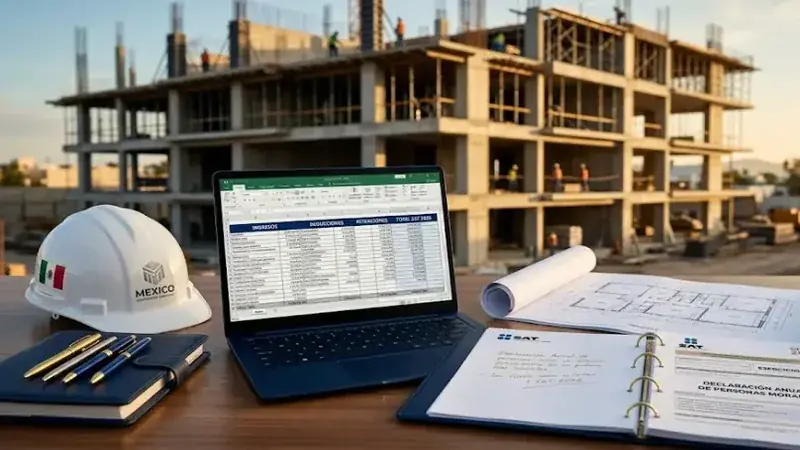
Construction contractor vs. real estate developer: why the distinction determines everything
Mexico's construction sector encompasses two fundamentally different business models, each with its own tax treatment. Before setting up accounting systems or discussing tax strategy, it's essential to identify which category applies — because the fiscal obligations differ significantly.
A construction contractor signs project agreements with clients (government, private companies, or individuals) and builds something that belongs to the client from day one. Revenue comes from certified progress billings. The specific income recognition rules under Art. 17 LISR apply, and the critical compliance risks involve REPSE for subcontracting, construction worker payroll with IMSS, and the correct timing of CFDI issuance for each progress billing.
A real estate developer purchases land, builds on it, and then sells the completed properties. Income is generated at the point of sale, not during construction. The tax complexities here are different: IVA treatment of different property types, mandatory Vulnerable Activities (anti-money laundering) compliance, and legal structure choices between SA de CV, trusts (fideicomisos), or combinations.
Many companies operate as both simultaneously — building under contract for third parties while also developing their own projects for sale. In those cases, accounting must segregate revenues by activity type, because the fiscal treatment is different for each stream.
Income recognition under Art. 17 LISR: the rule that construction companies cannot ignore
Article 17 of the Income Tax Law (LISR) establishes that revenues for corporations are recognized when the first of these events occurs: when the CFDI (fiscal invoice) is issued, when the good or service is delivered, or when full or partial payment is received. For construction contracts, SAT accepts the progress billing model as a valid income recognition method.
In practice: if you sign an $8,000,000 MXN contract to build a warehouse complex and your engineers certify 25% physical progress at month one ($2,000,000 MXN), you must issue the billing CFDI for that amount in that period and declare the income in your monthly ISR and IVA returns. The final payment upon project completion is recognized in the period it is received.
The most expensive mistake in this area is collecting large advance payments at project start without issuing the corresponding CFDI at that moment. "The work hasn't started yet" is not an acceptable reason under Art. 17 LISR — the advance payment is income the moment it enters the bank account. SAT cross-references bank statements with issued CFDIs as standard audit procedure. A $2,400,000 MXN advance received in January but not invoiced until July creates six months of undeclared ISR and IVA, plus the 1.47% monthly surcharge rate (2026).
IVA on real estate transactions: what's exempt, what's taxed, and the urbanized lot trap
IVA treatment in Mexico's real estate sector depends entirely on the specific type of transaction. Article 9 of the IVA Law (LIVA) creates exemptions that are more limited than most developers assume.
| Transaction type | IVA treatment | Legal basis |
|---|---|---|
| Sale of bare, undeveloped land (terreno baldío) | Exempt | Art. 9, sec. I LIVA |
| Sale of urbanized lot with installed infrastructure (water, drainage, paving) | 16% — taxable | SAT criterion: treated as "construction attached to land" |
| Sale of residential home (new or used) | Exempt | Art. 9, sec. II LIVA |
| Sale of commercial space or office (new or used) | 16% — taxable | Casa habitación exemption does not apply |
| Construction services provided to a client | 16% — taxable | Art. 14 LIVA — services |
| Rental of residential property | Exempt | Art. 20, sec. II LIVA |
| Rental of commercial or office space | 16% — taxable | Art. 14 LIVA |
The urbanized lot issue deserves particular attention. A developer who purchases agricultural land, installs drainage, brings in drinking water, paves the internal roads and then sells 500 m² individual parcels is not selling "land" in the tax sense. SAT classifies these as constructions attached to the ground — meaning the sales may be subject to 16% IVA unless the buyers are building residential homes, in which case the exemption applies to the final residential use. For mixed-use developments (part residential, part commercial), the solution is to document the intended use of each unit contractually from the moment of the promissory sale agreement. Trying to reclassify after the fact is not effective.
REPSE: the registration that makes or breaks your subcontracting deductions
Mexico's 2021 labor reform fundamentally changed how construction companies can engage subcontractors. Today, any company that provides specialized services or specialized construction work for a third party must hold a current REPSE registration (Registry of Specialized Service Providers and Specialized Work Contractors, issued by IMSS). For construction companies hiring specialist subcontractors — electricians, plumbers, finishers, structural engineers — this means verifying REPSE status before every payment, not just at contract signing.
If you pay a subcontractor who lacks a current REPSE registration: the expense is not deductible for ISR, the IVA they charged is not creditable, and the authorities may presume an employment relationship with the subcontractor's workers. The REPSE certificate is valid for 3 years and is verifiable online through the IMSS portal. The most common scenario is not a provider who never had REPSE — it's one whose certificate expired 4 months ago while a long-term project was still ongoing. Nexoconsult recommends including in all specialized service contracts a clause requiring the provider to maintain valid REPSE as a condition of payment, with monthly verification built into the accounts payable process.
Vulnerable Activities compliance: the obligation most developers have never heard of
Mexico's Anti-Money Laundering Law (Ley Federal para la Prevención e Identificación de Operaciones con Recursos de Procedencia Ilícita, LFPIORPI) explicitly includes construction companies, real estate developers and real estate agents as regulated entities under Vulnerable Activities. The compliance obligations are concrete and ongoing — not a one-time registration.
Companies must register in the SAT Vulnerable Activities registry (separate from their regular RFC registration), conduct client due diligence for each real estate transaction (official ID, CURP, RFC, income verification, and beneficial ownership identification for corporate buyers), submit monthly notices to SAT when transaction amounts exceed the legally established thresholds, and retain all client documentation for a minimum of 10 years. Non-compliance fines range from $310,000 to $5,200,000 MXN per event under Article 55 LFPIORPI. If your company has been operating for more than a year without completing this registration, voluntary proactive compliance — before receiving a formal SAT notice — is always the less costly path. Nexoconsult can guide you through the regularization process and establish the monthly reporting workflow going forward.
IMSS and payroll for construction workers: the specific rules that apply
Construction company payroll has characteristics that set it apart from most industries. Workers in construction are classified by IMSS under a higher work-risk category, resulting in a work-risk insurance premium that typically ranges from 3% to 7.6% of the contribution salary base — compared to 0.54% for low-risk service companies. The actual premium depends on the company's historical accident rate and IMSS classification.
The other significant feature is the legally recognized temporary worker registration. In construction, it is standard and legally valid to hire temporary workers and register them with IMSS as "eventuales" — with mandatory registration before their first day and mandatory deregistration on their last. If the same person works three separate projects with the same company throughout the year, each phase requires its own registration entry and exit. Common errors that generate retroactive IMSS claims include: not registering workers because they are "part of the foreman's crew" (employer liability persists regardless), paying cash wages without CFDI-stamped payroll receipts, and failing to manage worker registration timing on project transitions.
Legal structure for construction and real estate: SA de CV vs. fideicomiso
Most mid-size construction companies operate as an SA de CV under the General Tax Regime with 30% ISR on taxable profit. This structure is the most operationally flexible: it allows hiring employees, opening bank accounts, signing contracts, issuing CFDI and managing credit lines without restrictions.
For larger real estate developments — particularly those involving multiple investors, long timelines (3 to 7 years), or the need to legally isolate each project's risk — a real estate fideicomiso (trust) offers important advantages. Assets held in a fideicomiso are legally separate from the trustee company's balance sheet. If the construction company faces a labor lawsuit, the project land held in the fideicomiso is not attachable. Each project in its own fideicomiso means that problems in one project don't drag down others.
A widely used hybrid structure: the SA de CV operates as the construction company (employment contracts, REPSE registration, material purchases), while the fideicomiso holds the land and project rights. This separates operational risk from asset risk. For a foreign investor establishing a construction or development company in Mexico, the structure choice must be made before the first land acquisition — restructuring after project launch carries notarial and tax costs that can reach 3%–5% of the property value. The annual corporate tax return strategy also differs significantly between these two structures, which affects post-project distribution planning.
Nexoconsult advises construction and real estate companies on correct fiscal structuring from company formation, contract design with REPSE clauses, Vulnerable Activities compliance setup, and monthly ISR and IVA management. View plans and pricing here.